From BASIC to Cyberpunk
My interest in game development began in the mid-1980s—it sparked a fascination with systems, decisions, and consequences. Decades later, that curiosity has evolved into a new cyberpunk project exploring how technology, incentives, and human judgment interact in a near-future world.
Where This Started
My interest in game development dates back to around 1984.
I remember reading a BASIC programming book that featured a simple roulette game. I carefully typed the code, and it worked. You entered a number, and the computer then generated a random value. If your guess was correct, you won. It was primitive by today's standards, but back then, it was the greatest thing.
By 1987, I was learning Pascal, then Turbo Pascal. I kept using it throughout university, and even now, Pascal — now in Delphi — remains one of my favorite languages.
Early Game Influence
In the late 1980s and early 1990s, I played the Space Quest series I to III. Those games were comedic adventure titles, but structurally, they were well-designed.
These games featured systems such as:
- Exploration
- Environmental interaction
- Consequences for poor decisions
For years, I wanted to create something similar.
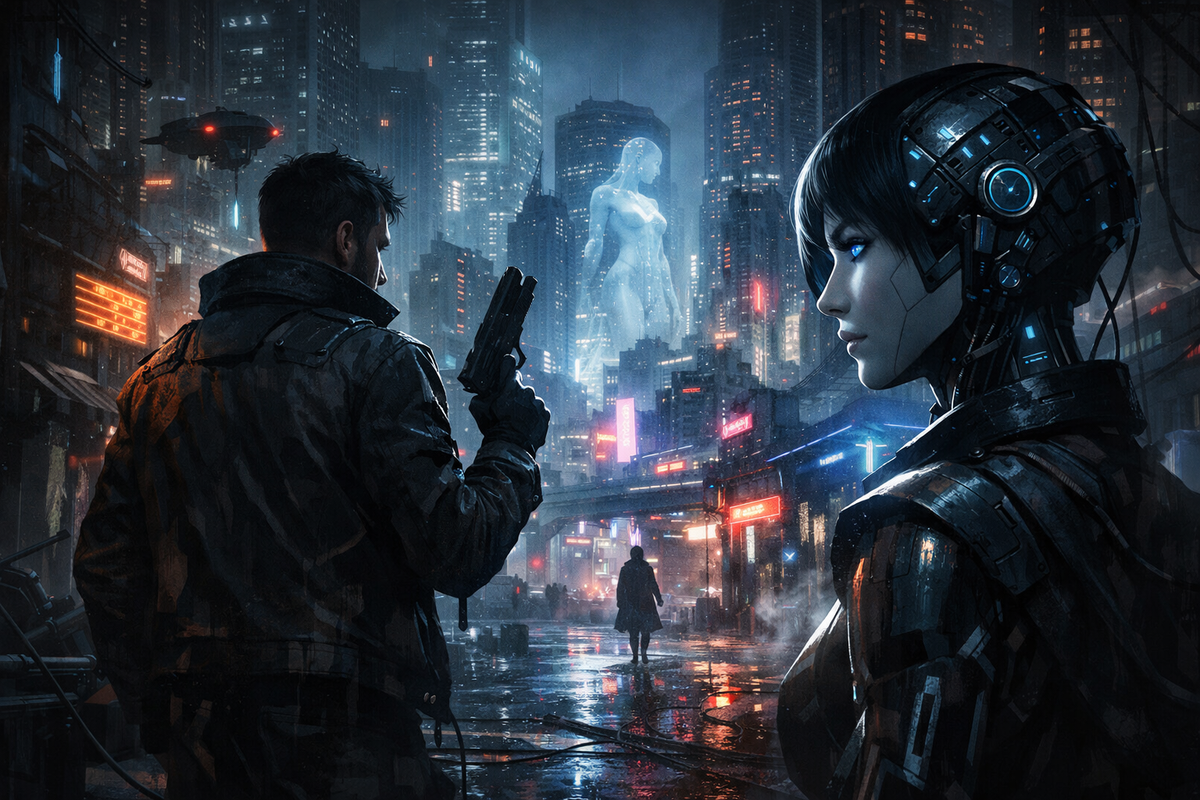
From Space Opera to Cyberpunk
I have always been interested in robots and space.
Series like Mobile Suit Gundam: The Origin explore conflict through massive mechanized warfare. But over time, distant galaxies and large-scale space opera began to feel detached.
Cyberpunk is different:
- The protagonist is human.
- Not far-future fantasy.
- Not mythic space battles.
- Near-plausible Earth.
- Technology is transforming how humans connect.
- A future that feels like an extension of today.
Films like Blade Runner and Ghost in the Shell ask uncomfortable questions such as:
- What defines a human?
- Is consciousness biological?
- Who owns intelligence?
- Who controls technology?
One moment in Ghost in the Shell crystallized it for me.

Major Kusanagi wonders:
What if a cyberbrain could possibly generate its own ghost… create a soul all by itself?
And if it did… what would be the importance of being human then?
That question feels more relevant now than ever.
Technology and Incentives
There seems to be a recurring pattern in history:
- New technology appears.
- Its long-term consequences are unclear.
- Over time, the incentives surrounding that technology begin to shape how it is used.
- Technology itself is neutral.
- Systems are not.
Economic incentives, political pressure, and institutional goals gradually redirect technology away from its original purpose.
This is the philosophical foundation of the game I am building:
A near-future world where well-meaning technologies are repurposed for control, manipulation, and power consolidation—not because of evil masterminds like Dr. Evil, but because the surrounding systems reward those outcomes.
Character Architecture: Why Get Smart Matters
Another unexpected inspiration comes from Get Smart—specifically, the dynamic between Maxwell Smart (Agent 86) and Agent 99.
Agent 86 is impulsive, flawed, overconfident — but sincere. Agent 99 is composed, analytical, perceptive — often the stabilizing force. That contrast creates tension. More importantly, it creates balance.
For this project, I am exploring a similar structure:
- The player character will resemble Agent 86 — human, imperfect, forced into difficult situations.
- The AI companion will resemble Agent 99 — human, composed, analytical, morally reflective.
But here is the twist:
The AI companion might not only serve as an assistant. It might evolve, disagree, influence outcomes, and build its own way of understanding events.
This dynamic is not comic relief. The AI companion becomes part of the game's decision architecture—an analytical counterpart to the player whose recommendations, objections, and interpretations shape how choices are evaluated.
The tension between human instinct and artificial analysis becomes part of the gameplay.
What This Means for the Game
This project is not about shooting enemies in a dystopian city.
It is about:
- Making difficult decisions about human-like lifeforms
- Navigating ambiguous legal and moral territory
- Managing a relationship with an AI that may not remain static
- Operating inside systems shaped by technological abuse
It combines:
- The structured logic of early adventure games
- Cyberpunk’s philosophical tension
- A relational dynamic inspired by Agent 86 and Agent 99
The result should feel less like a power fantasy and more like controlled instability. A system under pressure.
Next Step
In future Devlogs, I will shift from philosophy to technical topics. In other words, I will focus on turning my vision into a playable game.
- Level layout
- Player movement
- Companion AI architecture
- Dialogue system direction
- Player decision tracking
- Long-term consequence modeling
Because inspiration matters. But discipline and structure determine whether the idea survives.